
Your phone probably wakes you in the morning. Before you have even left your bed, you may have checked a message, looked at the weather, read the news or glanced at your calendar. Later, you might use the same device to navigate to work, make a payment, join a meeting, watch a video, attend an online class or speak to someone on the other side of the world.
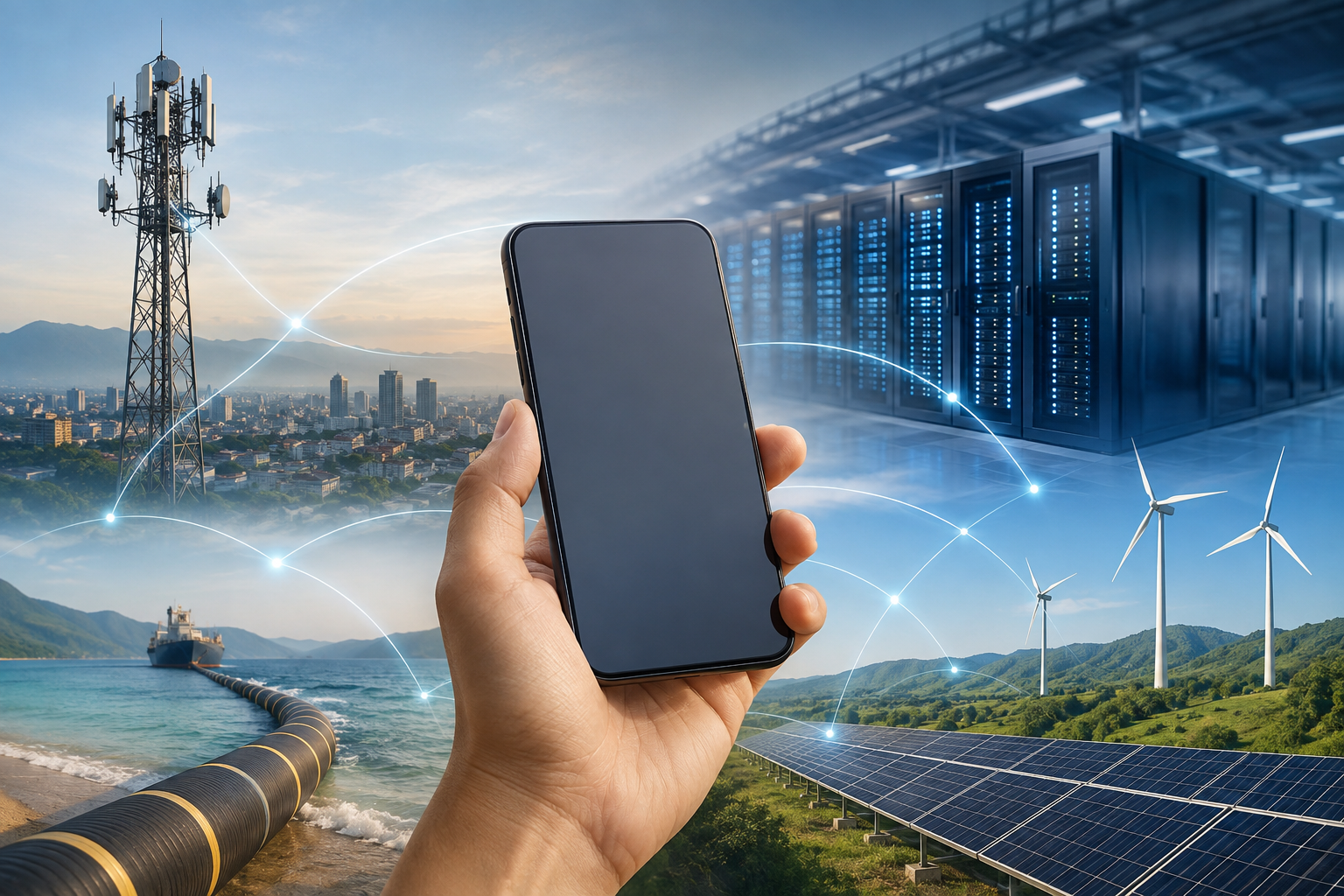
None of these actions feel particularly significant. You tap the screen and something happens almost instantly. What is easy to forget is that your phone is not operating alone. Behind that small device is a much larger system involving telecommunications networks, data centres, servers, storage systems, fibre-optic cables, mobile towers and electricity infrastructure. These systems must be manufactured, powered, maintained and eventually repaired, reused, recycled or replaced.
Your phone and the internet are so closely woven into daily life that it is easy to forget their physical systems. Every message, search, video call, online lesson, bank transfer and social-media post depends on infrastructure that uses energy and materials. The environmental consequences are difficult to see because most of the physical resources involved are somewhere else, either in a data centre, telecommunications network, factory, mine, warehouse or recycling facility.
Digital technology has transformed how people communicate, learn, work and participate in society. For billions of people, connectivity provides access to information, services and opportunities that would otherwise be difficult to reach. The question is how we can remain connected while using digital technology more responsibly.
Your Phone Connects You to a Global System
A smartphone may fit in one hand, but it connects its user to a global physical system. When you send a message, the information does not simply disappear from one phone and appear on another. It may travel through a Wi-Fi router or mobile network, then through telecommunications infrastructure including fibre-optic networks, switches and routers. Depending on the service and destination, it may also pass through a data centre where information is processed, stored or routed.
The journey can be local or international. A message to someone nearby may rely mainly on local infrastructure, while a message to someone overseas may pass through systems across several countries. International connectivity depends heavily on submarine fibre-optic cables, which the International Telecommunication Union describes as carrying more than 99% of international data traffic.
The user sees none of this. We simply see a message being sent or a video playing. We describe services as “virtual” and say that information is stored “in the cloud”, but the cloud consists of physical data centres. Wireless connectivity relies on towers, antennas and network equipment. A phone contains metals, glass, plastics, a battery and sophisticated electronic components.
Connectivity Is Also a Social Good
The environmental discussion needs to be balanced against the social value of connectivity. The International Telecommunication Union estimates that approximately 6 billion people, or 74% of the world’s population, were online in 2025, while around 2.2 billion people remained offline.
For many people, internet access is no longer simply about entertainment or convenience. It can influence whether someone can attend an online class, apply for employment, access government services, communicate with relatives overseas, receive financial services, operate a small business or obtain important information. In some communities, a smartphone is the main connection to the digital economy.
This is where the social dimension of ESG becomes important. A sustainable digital future should not mean reducing access for people who remain excluded from the benefits of connectivity. The better objective is broader access with lower impact, with digital services that are more efficient, durable, affordable and responsibly managed.
The Electricity Behind Your Screen
Every digital service requires electricity. Your phone uses energy when it charges, receives information, displays a video or runs an application. Your Wi-Fi router may operate continuously. Mobile networks require power to provide coverage, while data centres use electricity for servers, storage, networking equipment and cooling.
The International Energy Agency estimates that data centres consumed approximately 415 terawatt-hours of electricity globally in 2024, representing around 1.5% of worldwide electricity consumption. Under its base case, data-centre electricity demand could reach approximately 945 TWh by 2030, more than twice the 2024 level.
These figures do not represent the electricity consumption of ordinary internet users alone. Data centres also support scientific research, healthcare, public administration, businesses and many other services. They nevertheless illustrate the scale of the infrastructure behind our digital lives.
Electricity consumption and carbon emissions are not the same thing. The carbon impact of electricity depends on how it is generated, while infrastructure efficiency determines how much electricity is required. A data centre powered largely by low-carbon electricity can therefore have a different carbon footprint from one operating on a more carbon-intensive grid.
There is no single universal figure for the carbon cost of sending a message, watching a video or conducting a search. The answer depends on the device, network, data centre, activity, electricity source and efficiency of the systems involved.
The Device in Your Hand Has a Lifecycle
The environmental cost of a phone begins before it is switched on. Materials must be extracted, processed and transported. Components are manufactured and assembled, and the finished product is packaged and distributed through global supply chains.
A phone’s environmental footprint is therefore not limited to the electricity used while charging it. An ADEME and France Nature Environnement assessment published in 2017 estimated that approximately three-quarters of a smartphone’s environmental footprint was concentrated in its manufacturing phase, including the extraction of raw materials and production of components. This figure comes from that specific assessment and should not be treated as a universal percentage for every smartphone or every environmental indicator. The broader conclusion remains important, where manufacturing is a major part of a smartphone’s environmental impact.
This changes how we should think about replacement. A new device may offer improved security, accessibility, battery performance or energy efficiency. An older phone may become unreliable or unable to receive essential security updates. In such circumstances, replacement may be reasonable.
However, a phone that remains secure, functional and suitable for its owner’s needs does not necessarily need to be replaced simply because a newer model is available. Repairing a damaged screen, replacing a battery where possible and maintaining software updates can extend its useful life. When a device is no longer needed, it may still be useful to another person through resale, donation, or refurbishment.
The end of a device’s life matters as much as its beginning. The Global E-waste Monitor 2024 reported that the world generated approximately 62 million tonnes of electronic waste in 2022. Only 22.3% were documented as formally collected and recycled. If current trends continue, global e-waste could reach approximately 82 million tonnes by 2030. E-waste is not simply unwanted rubbish. Electronics contain materials that require energy and resources to extract and process. When devices are discarded without proper recovery, valuable materials can be lost, and pollution risks can increase.
For users, the practical response is straightforward. A working phone can be repaired, sold, or refurbished. A device that has genuinely reached the end of its useful life should enter an appropriate e-waste collection or recycling system rather than general waste.
Better Digital Habits
Individual users cannot control the design of global data centres, electricity grids or international supply chains. Governments, manufacturers, telecommunications providers and large organisations have much greater influence over those systems. Users are nevertheless part of the demand that keeps the digital economy growing. The objective is not to feel guilty about every message, photograph or video. It is to become more deliberate about digital consumption.
Keeping devices longer when they remain secure and useful is one practical step. Digital storage deserves similar consideration. Cloud storage may feel unlimited because its physical infrastructure is invisible, but every stored file occupies capacity somewhere. Removing duplicate photographs, obsolete downloads and files that no longer have a purpose will not transform global energy consumption, but it encourages a more intentional approach to digital use.
Video quality can also be matched to the situation. The highest available resolution is valuable when viewing content on a large screen but may provide little additional benefit when watching a routine meeting or lecture on a small phone. Large files can also be managed more thoughtfully, when sharing a link to a central document may sometimes be preferable to repeatedly distributing multiple copies.
The same principle applies to artificial intelligence. AI can create substantial value in education, research and productivity, but the most computationally intensive option is not automatically necessary for every task. Using technology according to the actual requirement is a simple form of responsible digital behaviour.
Technology Can Also Be Part of the Solution
The environmental footprint of digital technology should not be considered in isolation. Digital services can also reduce environmental impact elsewhere. A video meeting requires computing and network infrastructure, but it may eliminate the need for someone to travel. Online learning can reduce journeys to training centres. Digital public services can reduce some physical visits. Remote work can reduce commuting for certain workers.
The appropriate comparison is therefore between digital activity and realistic alternative. A virtual meeting still has an environmental footprint, but it may be preferable to flying several people thousands of kilometres for a short meeting.
Digital technology is not automatically sustainable simply because it replaces a physical process. What matters is whether the digital solution creates sufficient value to justify the resources it consumes and whether the same outcome can be achieved more efficiently.
A More Responsible Digital Future
The internet has become one of the world’s most important infrastructures. It enables communication, employment and access to services, while creating opportunities for people who might otherwise remain disconnected from the wider economy and society. For those who are still offline, connectivity can provide access to opportunities that connected users often take for granted. The goal should therefore not be a less connected world, but a more responsible digital world.
That responsibility is shared. Technology manufacturers can design products that are more durable and repairable. Telecommunications providers can improve the efficiency of their networks. Governments can support connectivity, cleaner energy and effective e-waste management. Organisations can strengthen technology, lifecycle management and data governance, while users can make more thoughtful decisions about when they replace devices, what they store and how they dispose of electronics.
None of these actions will eliminate the environmental footprint of digital technology. They can, however, reduce unnecessary consumption while preserving the benefits that connectivity provides. The objective is not to use technology less for its own sake, but to use it with greater awareness of the resources required to make it possible.
Your phone brings the world into your hand, but it also connects you to a much larger physical system. Understanding that connection changes the way we think about everyday digital activity. The next time you consider replacing your phone, storing another thousand photographs or adopting a new digital service, ask yourself: “Is the value I am receiving worth the resources required to provide it?”
Responsible digital behaviour begins when we recognise that even the most convenient technology has a physical footprint.
